Plant milkweed so monarch butterflies can visit your home!
May 05, 2024
Next Post
Back Post

May 05, 2024
May 05, 2024
Original Article: Click Here By Mike Allen June 9, 2023 (Santee) — Padre Dam Water District’s board is fed up with having to pay higher rates for the water it purchases from the San Diego County Water Authority, and voted unanimously not to go along with any rate hike unless the CWA gets serious about […]
Original Article: Click Here
By Mike Allen
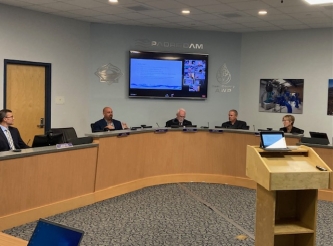
June 9, 2023 (Santee) — Padre Dam Water District’s board is fed up with having to pay higher rates for the water it purchases from the San Diego County Water Authority, and voted unanimously not to go along with any rate hike unless the CWA gets serious about its long-range planning.
The five-member board took the vote after listening to a presentation by CEO Kyle Swanson (photo, right)about CWA raising the wholesale rate charged to member water agencies next year by a range between 8.2 to 12.7 percent. At one point, CWA was considering increasing to about 13 percent, but the range is ever-changing and unknowable at the current time, Swanson said.
Several board members said they were upset over the four alternatives presented, especially after Padre Dam made a five-year commitment to keep its water rates flat.
“I have absolutely zero confidence in their zero to two percent projection (in one alternative),” said President Bill Pommering. “They’re not projecting properly. This board, which has worked so hard and diligently, was able to come up with a five-year plan where we’re not taking any internal rate increases. Unfortunately, we still have to pass on and there’s no way to avoid the rate increase from the County Water Authority and that’s a huge number and believe me, most people are going to come back and (say) that’s something we did. It isn’t.”
Last year Padre Dam used funds it obtained from a legal settlement to offset the increased costs for water it buys from the CWA as well as rate hikes by SDG&E to keep local water rates stable through the end of June.
But starting July 1, PDWD customers will see their water rate jump three percent as the subsidies expire. For those customers who live in higher elevation areas like Alpine, rate hikes by SDG&E will push their bills up so that a typical user will see at least a $5 increase in their monthly bill, according to data supplied by Padre Dam.
According to a survey done by the Otay Water District last year, Padre Dam has the highest water rates in San Diego County with an average monthly bill of $136.98 based on 2021 data. The next highest was Ramona Water District at $121.41. Those figures don’t include sewage costs, which are often higher than water.
Padre Dam Director Brian Fordyce said while he wasn’t in favor of any rate increase, the reality is that there will be one.
“The real issue isn’t the rate increase we’re talking about today. The real issue is there is no plan, and these rate (increases) are going to continue every single year. I believe we’ll be sitting here in a year, and will be looking at 12 or 13 percent (increase) no matter what happens today unless some plan gets put in place.”
The CWA board has signaled through earlier meetings that it will likely use its reserve balance to offset the higher costs of the imported water it receives from Los Angeles-based Metropolitan Water Authority. Those reserves have dropped to about $100 million today from about $400 million held in 2014, according to a Los Angeles Times report.
That caused concern by some board members that the depleted reserves could have a deleterious impact on the agency’s ability to pay past debts and impede borrowing for future projects.
Director Suzanne Till said complicating the issue is the fact that Padre Dam and other local water agencies are building major water reclamation projects that will result in not having to buy as much water from CWA.
Till and other directors noted that CWA is locked into long term contracts called “take or pay” that make no sense given the market realities today. For instance, the CWA has a contract to buy desalinated water from Poseidon in Carlsbad through 2045 at $2,800 per acre foot (about 326,000 gallons). Last year CWA was selling treated water to members agencies at about $1,800 an acre foot.
All 24 water agencies belonging to CWA are using less water as prices continue to rise and people conserve more. But because they’re using less, agencies are collecting less revenue.
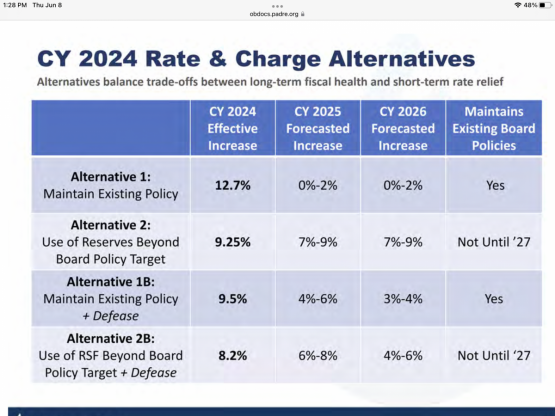
And yet, due to inflation and rising costs, the water agencies are forced to increase their rates,Till said.
“We’ve got to get out of the vicious cycle of the water use going down, and yet our rates are going up,” she said.
Swanson said the CWA is projecting ever increasing water use over the next several years but that doesn’t make sense given that water reclamation projects like the East County Advanced Water Purification Program and Pure Water in San Diego will begin producing more local water, thus reducing demand for CWA’s wholesale water.
In his letter to CWA objecting to the proposed higher rates for the next two years, Swanson said it is unlikely that local demand will increase by 10 percent over the next five years.
“What is more likely is that the expected growth in demand will not occur and CWA member agencies will continue to experience double digit increases unless significant adjustments are made,” Swanson wrote.
He offered several strategies that CWA could follow to reduce its costs including deferring non-critical capital improvements such as the San Vicente Pumped Storage project until grant funding is secured; cutting or delaying adding staff positions; reducing the debt service ratio; and finally, providing a five year forecast instead of the current three year model.
The CWA board is expected to take up the issue of its wholesale rate increase at its June 22 meeting.
Apr 18, 2024
When the project goes online by winter 2026, some customers in Padre Dam Municipal Water District and Helix, Lakeside and Otay water districts will receive some of the water that passes through here Original Article: Click Here Work has been underway on a recycled water treatment project in Santee for about two years. In another two years, […]
Original Article: Click Here
Work has been underway on a recycled water treatment project in Santee for about two years. In another two years, some East County residents will get their drinking water from the East County Advanced Water Purification program.
It’s a massive billion-dollar recycled water treatment plant north of Santee Lakes that, at its peak, has 250 construction workers working on it.
Kyle Swanson, the CEO and general manager at the Padre Dam Municipal Water District, says the project will meet about 30% of drinking water demands in East County alone. Right now, most East County residents get their water from Northern California and the Colorado River, according to Swanson.
“This is a needed project that would be an answer to the drought that regularly plagues San Diego County,” Swanson said.
When the project goes online by winter 2026, some customers in Padre Dam Municipal Water District and Helix, Lakeside and Otay water districts will receive some of the water that passes through here.
Swanson explains how it will work.
”There is wastewater generated in East County. That’s going to be sent up to a treatment plant for processing. That’ll produce recycled water,” Swanson said. “It’ll go through another advanced water purification project to produce purified water. That purified water will get pumped through Lake Jennings, which is a surface body reservoir in Lakeside.”
Swanson says the water will sit in Lake Jennings for four to six months and then move to be treated at a drinking water treatment facility before it reaches homes. In addition to water supply, Swanson says it comes with other advantages too. Three megawatts of renewable energy will be generated from digester biogas and organic waste, which will supply up to 60% of part of the program’s electricity.
“There’s also a benefit of offloading wastewater that’s currently being treated and dumped out to the Pacific Ocean, so there’s a significant environmental impact,” Swanson said.
In terms of the cost to customers, Swanson says they shouldn’t expect an increase.
“We don’t anticipate it changing,” Swanson said. “In fact, this project moving forward was cost competitive with importing water and delivering wastewater for treatment into the San Diego region.”
With so much construction happening inside the future facility, Swanson reminds commuters of what they can see out on the roads
“There’s also approximately 30 miles of pipeline being constructed,” Swanson said. “Currently, the pipeline for the conveyance of the purified water is about 30% complete moving through the communities of Santee and Lakeside.”
Mar 18, 2024
Original Article: Click Here A new recycled wastewater facility is under construction. By: Spencer Soicher SANTEE, Calif. (KGTV) — In the near future, recycled wastewater could account for 30% of the drinkable water in the East county. The water would go through several purification steps at a new facility being built in Santee. More than 10 […]
Original Article: Click Here
By: Spencer Soicher
SANTEE, Calif. (KGTV) — In the near future, recycled wastewater could account for 30% of the drinkable water in the East county. The water would go through several purification steps at a new facility being built in Santee.
More than 10 years and $950 million after the project began, the East County Advanced Water purification is just a few years away from opening.
The facility will provide water to East County in a sustainable way.
“There are drought impacts on the Colorado River in northern California where we get our imported water from. So it’s a needed resource right here in our community,” Kyle Swanson, the CEO of the Padre Dam Municipal Water District says.
California passed new laws in 2023, laying out regulations for converting wastewater into tap water.
Similar facilities have rolled out in several states, and southern California already has one in Orange County. But the East County project is a little bit different.
“The East County Advanced Water Purification Project will take that purified water and put it into a storage reservoir,” Swanson adds.
Construction on the project is only halfway done, with an estimated completion date at the end of 2026. “It is incredibly important. It offloads the need to import water,” Swanson adds.
Funding for the water facility has come from multiple avenues. That includes $760 million in loans and $169 million in grants. The facility is owned by Padre Dam, the city of El Cajon, San Diego County, and Helix Water District.
May 05, 2024
Original Article: Click Here By Mike Allen August 4, 2023 (Santee) — One year into the construction of the $950 million East County Advanced Water Purification Program (AWP_, the largest infrastructure project in the region’s history is starting to take shape. Huge concrete and steel structures with names such as digesters, headworks, clarifiers, equalization tanks, […]
Original Article: Click Here
By Mike Allen
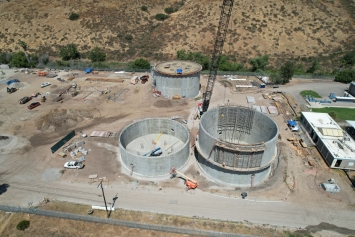
August 4, 2023 (Santee) — One year into the construction of the $950 million East County Advanced Water Purification Program (AWP_, the largest infrastructure project in the region’s history is starting to take shape.
Huge concrete and steel structures with names such as digesters, headworks, clarifiers, equalization tanks, and aeration basins are sprouting at the end of Fanita Parkway in Santee where the Ray Stoyer Water Recycling Plant used to exist.
The facility that once produced some 2 million gallons of water used for irrigation is being transformed to a far larger entity that will produce some 11.5 million gallons of drinkable water daily for about 500,000 East County residents.
The massive project has been planned for about a decade, and broke ground in June 2022. It’s scheduled to be finished by the end of 2025, and begin operating by 2026.
The lead agency for AWP, the Padre Dam Municipal Water District, provided ECM with a recent tour of the site to give a glimpse into how things are unfolding. Three other agencies make up a joint powers agency that oversees AWP: the county of San Diego, the city of El Cajon, and the Helix Water District.
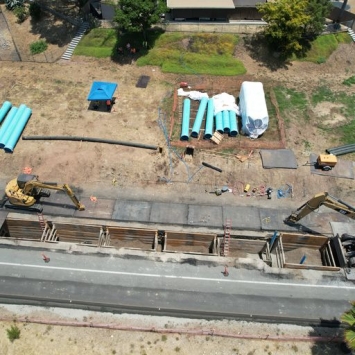
Plenty of advance notice was given for the traffic disruption on that street and Mast Boulevard by Padre Dam, but delays are inevitable when a project of this scope is being built, water officials said.
At its peak, the AWP will have some 250 workers on the job toiling on five different packages, the largest of which covers the transformation of the Ray Stoyer facility, and is estimated at $460 million.
Package 2 entails an 11 mile pipeline that takes the near distilled quality water east to Lake Jennings. Package 3 consists of changes to the existing Mission Gorge Pump Station, and pipes connecting to the new water recycling plant and a brine line connecting to the city of San Diego’s sewage lines.
San Diego is concurrently building its own water reclamation system called Pure Water centered in Miramar at an estimated cost of $5 billion.
Similar water reclamation systems have been operating in Orange County, and other parts of Southern California for decades as the cost of importing water from the Colorado River and the Sacramento River Delta become too expensive. AWP is said to provide about 30 percent of the region’s supply once it’s completed.
Franz Schauer, construction manager for Package 1, said what’s being created is an expansion and enhancement of what was going on at the Ray Stoyer plant, which was created in the 1950s. Once the sludge goes through three levels of treatment to produce the same type of water at the old facility it goes through a final stage of purifying the water for drinking.
“If you want to call (the project) it’s really three treatment plants put together,” Schauer said. Once the process gets to the purification stage, the water goes through micro-filtration process, and finally to another larger building where it goes through reverse osmosis, he said.
At the end point, the near distilled quality water is pumped to Lake Jennings where it will be held and receive yet another level of purification before it’s pumped to customers.
After about a year, the AWP has spent $106 million in construction, installed some 875 linear feet of pipes, and poured some 10,000 cubic yards of concrete. The Package 1 contractor is a joint venture of AECOM and W.L. Lyles Construction.
The workers on this job usually possess more specialized skills endemic to wastewater treatment facilities, Schauer said.
“A lot of this work that we do in wastewater takes a special type of person. We’re not building a hotel, we’re not building a mall.”
Apr 25, 2024
Hike is expected to be passed on to customers, but amounts likely to vary by agency; increase slated to be somewhere between 16 percent and 22 percent in 2025
Original Article: Click Here
SAN DIEGO —
County water officials say the amount they charge local agencies for wholesale water must increase 39 percent over the next three years, including a hike between 16 percent and 22 percent during 2025.
The enormous increases will force local agencies to also raise rates, but how much of the hikes they pass on to customers will vary widely among the roughly two dozen agencies that buy from the County Water Authority.
Some agencies have large local supplies, like Sweetwater with its groundwater basin, that allow them to buy less from the county authority. But others, like the city of San Diego, rely on the authority for as much as 90 percent of their water.
Water authority officials said the fundamental problem is that they borrowed money to build and maintain a significantly larger water storage and delivery system than is needed.
Officials expected demand to continually grow as population increased and development expanded, but member agencies have been buying steadily less wholesale water during the last two decades.
While that has allowed the water authority to buy less imported water from outside the region, it hasn’t shrunk the fixed costs the authority faces to pay off construction bonds and maintain the system.
Lower demand for water is primarily the result of widespread conservation, replacement of grass with zeroscape yards and a shrinking farm industry, officials said.
And the problem is only expected to get worse over the next few years when three large agencies — San Diego, Oceanside and El Cajon — start recycling sewage into drinking water they can use instead of wholesale water.
The authority also faces short-term problems, including two consecutive remarkably wet winters that have sharply reduced the need for outdoor irrigation.
Water sales to local agencies were 36 percent below projections during January, February and March of this year. That comes after sales were 27 percent below estimates during 2023.
Another short-term problem is the departure from the water authority of agencies serving Fallbrook and Rainbow, which opted to get water from nearby Riverside County instead.
The authority is receiving exit fees from Fallbrook, which detached Jan. 1, and Rainbow, which is slated to detach this fall. But officials said those fees don’t cover the authority’s costs related to Fallbrook and Rainbow.
“Those agencies are no longer paying their fair share,” Pierce Rossum, the authority’s rate and debt manager, told the authority board Thursday afternoon in Kearny Mesa.
In addition, the Metropolitan Water District of Southern California has approved rate hikes of 8.5 percent each for both 2025 and 2026 that will increase the county authority’s costs.
The Los Angeles-based agency sells wholesale supplies to San Diego and transports the region’s Colorado River water.
And the county authority is also facing higher charges to produce water desalinated in Carlsbad, and other storage and supply costs officials say are outside their control.
The costs outside the authority’s control, which officials call external costs, make up about two-thirds of the 39 percent in total hikes officials say are required during 2025, 2026 and 2027.
Of the 16 percent to 22 percent hikes required in 2025, external costs account for 11 percent.
Authority officials are asking the 36-member board to decide whether they want to tack on either 5 percent, 9 percent or 11 percent to that external 11 percent.
Board members said Thursday that whether the increase next year ends up being 16 percent or 20 percent or 22 percent, it’s upsetting.
“Less than a year ago we had a rate chart of alternatives with a forecast increase of no more than 6 or 8 percent,” said Neal Meyers, a board member representing the Olivenhain Municipal Water District. “To be here and hearing 20 percent, that’s very frustrating.”
The 22 percent increase in 2025 would allow the authority to keep its cash flow at recommended levels and continue to make infrastructure investments that will keep water facilities reliable, officials said.
Shrinking the increase to 16 percent in 2025 would lower cash flow, possibly jeopardizing the authority’s credit rating, and force postponement of some infrastructure projects.
Gary Hurst, a board member representing the Ramona Municipal Water District, said he was not enthusiastic about delaying projects.
“What you’re really doing is creating a backlog of repair and replacement projects,” Hurst said. “You’re creating a giant hurdle for future financing.”
If the board opts for 16 percent in 2025, the increases in 2026 and 2027 would have to be sharper to get to the 39 percent total.
Joy Lyndes, a board member representing the San Dieguito Water District, said the sharp increases make sense if they are viewed as the first step of a long-term stabilization plan.
“There’s a lot that’s happened to us in the last few years that we’re responding to now,” Lyndes said. “We have to really make some corrections and it may take us five to 10 years.”
Authority officials said they expect the board to decide on the 2025 rate increase in May and finalize it in June.